
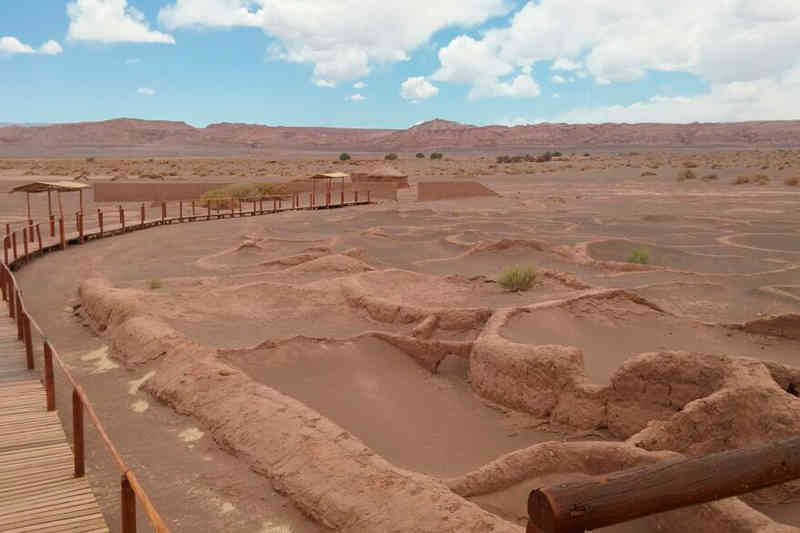
The Aldea de Tulor is one of the most important archaeological sites in northern Chile with an age of 2,800 years before the present, which was inhabited for 800 years. Its development corresponds to the period of early agriculture and pottery of the Atacama culture. Located in an area of 5,600 m2, it consists of a group of 26 circular houses built of mud and connected by passages that form labyrinths totaling 106 buildings. It is estimated that in this place lived around 200 people. The site is part of the National Reserve Los Flamencos.
In Antofagasta Region, located 7 kilometers South of San Pedro de Atacama, 328 km northeast of the city of Antofagasta and 1,670 km from Santiago.
During the beginning of the Christian era, Tulor could be an important port of trade and exchange of goods through camelids transport allowed to integrate a wide territory and cultures in the desert. The site was discovered in 1956 by the Belgian Jesuit priest Gustavo Le Paige, who was a leading researcher of the Atacama culture for 25 years. In 1982 the 10% of the village was unearthed by the Chilean archaeologist Ana Maria Baron.
Currently the new Gustavo Le Paige Museum is being built in San Pedro de Atacama, which stores the remains found in the Tulor Village. The new units will have 3,358 square meters to house the current collection consisting of 8 permanent exhibition rooms, 2 rooms for periodic samples, conservation vaults, research laboratories and academic areas.
Administration in the Ayllú de Solcor +56 552851608 and +56 982485000. E-mail: [email protected]. www. conaf.cl/parques/reserva-nacional-los-flamencos
Tour: The visit can be done individually or by hiring a tour in an agency at www. turistour.cl for $25,000 chilean pesos per person.
Project developed with the support of: