
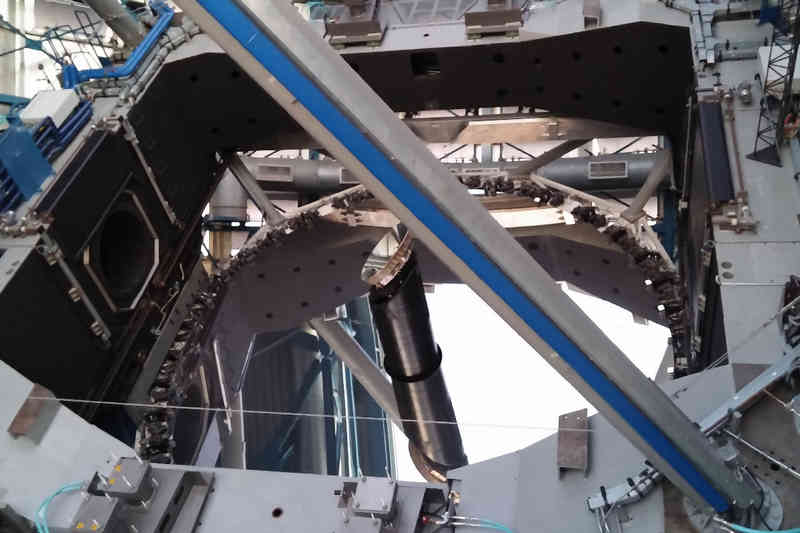
Paranal is the most important infrared optical astronomical center in the world. It belongs to the European Southern Observatory (ESO). It is composed of the Very Large Telescope (VLT), which has four telescopes with mirrors of 8.2 meters in diameter. The observatory also has four auxiliary telescopes with mirrors of 1.8 meters in diameter; a telescope called the VLT Survey Telescope (VST) with a 2.5 meter diameter mirror and the Visible & Infrared Survey Telescope for Astronomy (VISTA) with a 4 meter diameter mirror. Some of the discoveries made by this observatory are the first image of an exoplanet (a planet out of the Solar System) with the VLT telescope.
Located in the Region of Antofagasta 130 km south of the city Antofagasta in the commune of Tal Tal, 2,635 meters above sea level.
Arrive by plane to Antofagasta. Then by car take the Avenida Costanera until you reach the South exit of the city until the Route 5 North. Then, drive in south direction and take the exit to route B-70. Continue on this road for about an hour until the signs of the European Southern Observatory (ESO) on the right side of the road appear.
In 1988 the Government of Chile donated 72,500 hectares to ESO for the construction of the astronomical observatory. In 1996, it was symbolically inaugurated by the then President Eduardo Frei Ruiz-Tagle and the King of Sweden, Carlos XVI Gustavo. In 1998, the first telescope to enter into operation was Antú (Sol) of the VLT. The first images corresponded to the star Eta Carinae. In 2000 Küyén (Luna) was inaugurated, and in 2001, Yepún (Venus) and Melipal (Southern Cross), in June and August respectively.
At Cerro Armazones, located 20 km east of Paranal, the world's largest telescope is being built, named European Extremely Large Telescope or E-ELT. This project aims to observe the Universe with even greater detail than the Hubble Space Telescope. The primary mirror of 39 meters in diameter will enable the study of atmospheres and planets outside the Solar System. It will have a huge rotating dome of 85 meters in diameter, with a total mass of about 5,000 tons. This project will cost $ 1.4 billion and will be operational in 2024.
Registration for free tours at www.eso.org/public/chile/about-eso/visitors/paranal
Project developed with the support of: